Showing posts with label photography. Show all posts

Monday, May 12, 2014

The Sepia Editions


I have always loved sepia photography, but have never used that mode myself.  Now, for the sake of doing something a little different, I am posting these photos from my trip yesterday to Sedona and Prescott. Enjoy.


A play with shadow and light.


One solitary tree stands in the distance.


Tuesday, August 14, 2012

Architectural Gems of Uptown, Chicago

Uptown is the community closest to my neighborhood in Chicago. At one time, in the early and middle 20th century, Uptown was a socio-economically upscale neighborhood, and great effort was made to construct grand buildings that signified the status of Uptown residents and their upward aspirations. The neighborhood's past is still reflected in the older buildings that remain standing today. Here are a few of the buildings that stand out most vividly, as far as I am concerned.

Uptown Theater, Chicago, IL
During the 1990s, there was an organized movement to fully restore the Uptown Theater and make it an active business again. To my knowledge, that effort has stalled. The interior is supposed to be equally beautiful, but I have never been inside to be able to say for sure.

Bridgeview (formerly Uptown National) Bank, Chicago, IL
Formerly Uptown National Bank of Chicago, this Bridgeview Bank location has been in existence since, I believe, the late 1920s. As you can see, the exterior of the bank is undergoing some work.

Ceiling detail, main lobby, Bridgeview Bank, Chicago, IL
The main lobby of the bank is highly ornate and gorgeous. I believe it has been used as background in a couple of movies, but I can't recall that for sure. A long time ago, I used to work at this bank and never ceased to marvel at the main lobby's beauty.

Ceiling detail, main lobby, Bridgeview Bank, Chicago, IL

Teller stations and desk, Bridgeview Bank, Chicago, IL
I like how many of the original furnishings of the main lobby have remained intact over the decades. All of the old fashioned details make you feel like you've stepped into another time.

Ceiling detail, Bridgeview Bank, Chicago, IL

Old Goldblatt's Building, Chicago, IL
This building, constructed with a neo-classical design, used to house Goldblatt's, a local department store. Since then, it was converted into a Borders Books, but was abandoned when Borders experienced financial difficulties. I have no idea when a new tenant will inhabit this historic space. It's a shame to see it empty.

Door, old Goldblatt's Building, Chicago, IL

Uptown Broadway Building, Chicago, IL
This building is one of my favorites in Uptown, and instead of me babbling endlessly about it, I am going to let its architectural richness speak for itself. Photos displaying architectural details from this building follow below.

Architectural detail, Uptown Broadway Building, Chicago, IL

Architectural detail, Uptown Broadway Building, Chicago, IL

Main entrance, Uptown Broadway Building, Chicago, IL

Architectural detail, Uptown Broadway Building, Chicago, IL
Okay, one comment: I love the cornucopias featured on either side of this doorway architectural relief.

Chivalry is still alive!, Uptown Broadway Building, Chicago, IL

Top detail, Uptown Broadway Building, Chicago, IL

Architectural detail, Aragon Theater, Chicago, IL
The historic Aragon Theater is used today to house musical concerts. Its design is somewhat austere, offering architectural ornamentation in only a few areas of the building.

Architectural detail, Aragon Theater, Chicago, IL

Architectural detail, Aragon Theater, Chicago, IL
There are more beautiful buildings similar to these in Uptown, but these are my all-time favorites. I hope they will inspire you to go and see them for yourself.

Thursday, August 9, 2012

Reebie Storage Warehouse, Chicago

Built in 1921-1922, the Reebie Storage Warehouse in the Lincoln Park neighborhood of Chicago is a Chicago landmark and an excellent example of Egyptian revival architecture. Long ago, when I had an apartment nearby, I used to love walking by this building and savoring the details of this building's Egyptian motif. How beautiful, I would think, how incredible that we have such an architectural wonder in this neighborhood! Then I would think, how eccentric, how random, that such an architectural style would be employed in the construction of a storage warehouse. That never quite made sense to me, but it never diminished my love for this building.

Overview of Reebie Storage Warehouse, Chicago, IL

These look like tulips (flower detail), Reebie Storage Warehouse, Chicago, IL

Egyptian detail, Reebie Storage Warehouse, Chicago, IL

Beetle and flowers window detail, Reebie Storage Warehouse, Chicago, IL 
I love the window detail, especially the blue beetle.

Column detail, Reebie Storage Warehouse, Chicago, IL
I love the detail and color of this column. It's very luxurious.

Twin statues of Ramses II, Reebie Storage Warehouse, Chicago, IL
It seems, from what I have read, that John and William Reebie, the founders of this moving and storage company, are represented by these two statues of Ramses II.

Ramses II and beetle, Reebie Storage Warehouse, Chicago, IL

Front entrance profile, Reebie Storage Warehouse, Chicago, IL

Column base, Reebie Storage Warehouse, Chicago, IL

Ramses II, Beetle, Reebie Storage Warehouse, Chicago, IL
I still love that beetle! The Egyptian decoration is just a fraction of this building; the rest of this building is very much your ordinary light-colored brick building. Still, the Egyptian architectural details are spectacular and they help to offset the simplicity of the brick exterior.

Egyptian detail, Reebie Storage Warehouse, Chicago, IL
The Reebie Storage Warehouse is an example of what I love about Chicago: architectural diversity. It helps to create a rich and complex cityscape.

Monday, August 6, 2012

Peace Garden, Chicago

Peace Garden, Uptown Neighborhood, Chicago, IL
This is not much more than a little garden nook in the middle of a city park, but Peace Garden has been in existence for a long time and provides a nice respite from busy city life. Located just south of Montrose Avenue, it features a little waterfall with stone accents, including places to sit and enjoy the flowers in bloom. The limbs of large trees overhang and provide shade from the sun. While Peace Garden is nothing spectacular or extravagant, I have always found this modest patch of park to be magical. Even in the midst of so much activity, there is a soothing stillness in this little garden, something that can instill calm. Peace Garden can easily serve as a meditation garden. Maybe if more people engaged in meditation, practicing mindfulness over their thoughts and feelings and learning to embrace the present moment, then mindless acts of violence might cease to happen in this oftentimes troubled world. There's always room for hope.
This pole wishes for peace everywhere
While I captured this side of the pole that only wishes for peace in Chicago, this pole has a message engraved on each side wishing for peace in Illinois, the United States, and the entire world. But maybe this photo, starting at the micro-level, is an indication of the proper direction for promoting peace in the world. We're a culture enslaved by impulsiveness and the egotism of a popular culture that celebrates materialism and aggression. We cannot effectively promote peace in the world if we do not first cultivate peace within ourselves, and then work outward. Such quiet places as Peace Garden can make for a perfect place to begin the meditative process. But you don't need a special park to start. You can start meditation or engage in heart-felt prayer anywhere, including the middle of your living room. We need to look inward, understanding how we react to moments of stress and insecurity, patiently giving these reactions our mindful presence, and learning to open that tight fist of a heart into an open palm offering an abundance of peace, love, and compassion. Peace can start now, but it must begin with you and me. It is an inward process that unfolds outward, like a flower blooming and bringing beauty to a garden, beauty that can inspire peace in all of its beholders. So, let us start to promote peace with each mindful breath and the stillness of lovingkindness. Enjoy these photos.
Above, joggers run by as water ripples down the fall

Flowers bloom in the midst of the city

People coming together to play (and live) in friendship

The waterfall provides a nice, soothing rhythm

This nearby prairie in the park celebrates Illinois' botanical heritage

Saturday, August 4, 2012

Contemplation

Looking up at the John Hancock Center, Chicago, IL
This is the view of the John Hancock Center that I enjoy when leaving Water Tower Plaza to head to the shopping mall, Water Tower Place, part of which is the grayish white building at the bottom. As I have mentioned before, when going downtown, after walking about for a while, I like to get a cup of mint tea or ginger peach iced tea from Argo Tea, and head to the Water Tower Plaza to sit and watch the world go by. Groups of people walk by with each green traffic light giving them a pass, some carrying shopping bags and some, like me on this day, having cameras to take photographs. Taking a seat at Water Tower Plaza is a great way to see Chicago in action and to enjoy the dappled light that streams through the park trees' green leaves.

I have been enjoying the opportunity to take these photos of my hometown. It's more than just a way of saying goodbye, it's a way of honoring Chicago, of paying it my respect. Walking down the city streets, I encounter so many memories. I have had friends ask me if I am sure that I want to move back out West, especially now that taking all of these photographs is highlighting my appreciation for my hometown. I say, "yes," readily. It's not because I don't love my hometown that I am leaving it. I am leaving because I want to encounter something new, something with a more open range of sky, a city that integrates the organicism of nature more deeply into its cityscape.

I miss desert and mountains, and there is so much of the American West that I have yet to see: Yosemite; Joshua Tree National Park; Organ Pipe Cactus National Monument; Arches National Park; getting back to the Grand Canyon. And I want to take photographs of all these places when I visit them. Which brings me to one of my great desires: I want to find new subject matter for my photography. I will start that mission in miniature now. I have taken so many photos of famous Chicago landmarks; now I am going to turn some of my attention to capturing life in some of my favorite Chicago neighborhoods, just to paint a fuller portrait of everyday life in this city.

Check it out: Argo Tea

Friday, August 3, 2012

Saying Goodbye to Chicago, Part Eighteen: The Loop, Vol. Five

James R. Thompson Center

James R. Thompson Center, Chicago, IL
I always call this the State of Illinois Building and so had to correct myself in naming it here. It was actually renamed in 1993 after one of our governors. The building opened in 1985 and was designed by Helmut Jahn, who, if I recall correctly, used the Thompson Center as inspiration for one of his architectural designs in Germany.

Interior and elevator, James R. Thompson Center, Chicago, IL
What I like most about the interior is its use of color and natural light. I also like its spaciousness, but I do wonder if the way that spaciousness was created has led to wastefulness, as there is a lot of open space that is not being utilized. The first two or three floors are devoted to retail use, while the State of Illinois has offices on the remaining floors.

Glass ceiling, James R. Thompson Center, Chicago, IL
Again, the use of a glass ceiling creates a naturally light and airy effect.

Side detail, James R. Thompson Center, Chicago, IL

Side detail, James R. Thompson Center, Chicago, IL
The red and the blue provide for a nice contrast with the neutral beige.

Outside James R. Thompson Center, United Building, Chicago flag, Chicago, IL 
The design of the Chicago flag is not random. The three white bars of the flag represent the three parts of the city, the North, West, and South sides. The top blue bar symbolizes Lake Michigan and the bottom blue bar represents the Chicago River. The red stars represent pivotal events in the first one hundred years of Chicago's history: the establishment of Fort Dearborn on the site that would eventually become downtown Chicago; the Great Chicago Fire of 1871; the World's Columbian Exposition in 1893 (the one featuring the White City); the last star stands for the Century of Progress Exposition of 1933, which, obviously, featured a modernist theme.

There was talk a couple of years ago of adding a fifth star to the Chicago flag, if Chicago were to host the 2016 Olympics, but Chicago lost that bid to Rio de Janeiro. Frankly, I am happy that there won't be an opportunity to add a fifth star to the flag, as I like the thought that the four stars symbolize critical events of the city's first one hundred years, when the city was just establishing itself first as a city and then as a commercial and cultural center. I think those should be considered foundational events set apart from everything that happens going forward. They stand as pillars of Chicago's first century, supporting its rise upward into the ranks of world-class cities.


Along the River

Trio: Marina City, IBM Plaza, and Trump Tower, Chicago, IL
I always thought the name Marina City was a funny one for these two residential towers, as they look more like honeycombs than anything associated with the sea, but then it would probably sound silly, and maybe inappropriate, to call this place Honey Town. The IBM Plaza in the middle is another one of Ludwig Mies van der Rohe's big box designs, and the skyscraper on the right is the (relatively) new Trump Tower Chicago.

In the distance, Intercontinental Hotel, the Wrigley Building, the Tribune Tower, Chicago, IL 
In the midst of the austerity of Chicago's modern architecture stand some of the beautifully more ornate "classic"buildings of the city: the domed Intercontinental Hotel, the white Wrigley Building, and the neo-Gothic Tribune Tower. The presence of historical buildings designed according to different sensibilities adds layers of architectural richness and complexity to Chicago's cityscape.

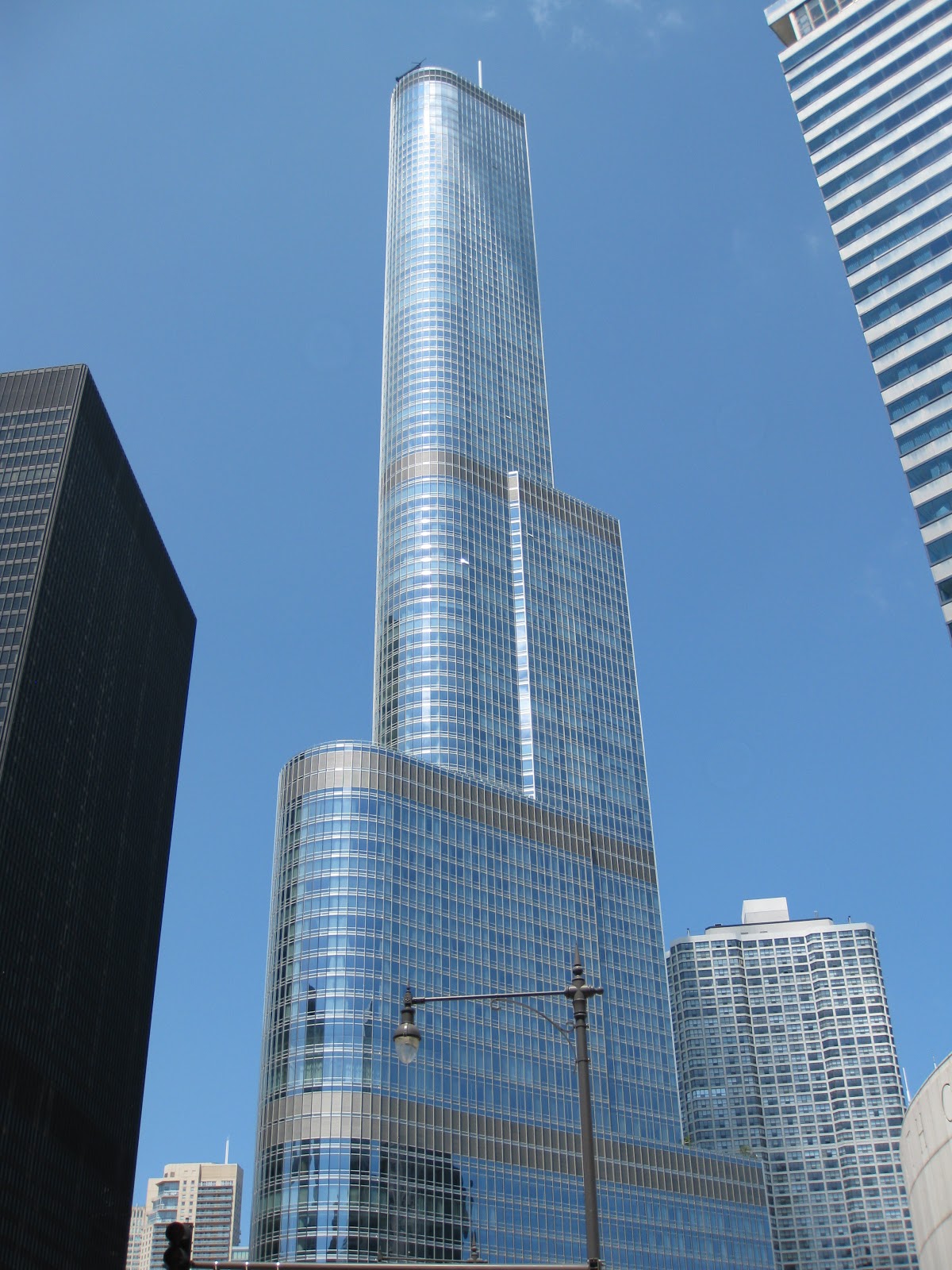
Trump Tower, Chicago, IL

Trump Tower and a bunch of buildings, Chicago, IL
Aqua

Aqua, Chicago, IL
Here is Aqua, one of the most beautiful of new skyscrapers to grace Chicago's skyline. The irregularity of its ridges, functioning as balconies for residents, creates a rippling effect, giving the observer the sense of water in motion and softening the edges of the building's overall rectangular structure.

Aqua, front view, Chicago, IL

Aqua is simply a brilliant piece of architecture. Another way to enjoy Aqua's beauty is by seeing it in collection with its neighboring skyscrapers from the vantage point of Millennium Park, which is just south of Aqua's location.