Showing posts with label the Loop. Show all posts
Sunday, December 21, 2014
Sears Tower Noir (Chicago, IL)
Growing up with the Sears Tower as part of my Chicago cityscape, I have long loved this skyscraper, and no other building in Chicago says "home" like it. Here is another "noirish" scene I captured last week, with the Sears Tower looming large over the streetscape and its antennae glowing in the evening dark. Just beautiful. By the way, I used part of my visit to continue my search for Willis Tower and still encountered no luck. I'll continue the search next time and keep you posted on the results.
Wednesday, December 18, 2013
Chicago Noir
This photo I took one evening on the walk back from Union Station, after spending the day in Milwaukee. I have always loved the art deco look of the Chicago Board of Trade building: simple but distinguished. Chicago is definitely a city with a dark edge to it, which is something that I love. It's a city with many dimensions to its character. This scene is just classic.
Tuesday, December 17, 2013
Sweet Home Chicago
The past is never really the past with me. It lingers and informs my present, colors my view of my future. It very much plays an instrumental role in shaping my identity, even when I am removed from the environment that gave it birth. That was the reminder that descended upon me during my recent trip back home. Christmas in Chicago, there's nothing like it, and it is the time of year when I miss my hometown the most. What will follow will be a series of photographs from my recent return visit, posted randomly and without concern for chronology or overarching theme, but there will be a logic to the organization of things. First, here is the beautiful and historic Chicago Theater welcoming me home.
Sunday, August 19, 2012
Moving On
| Nature boardwalk, Lincoln Park, Chicago, IL |
Above is the southern stretch of Lincoln Park, near the Farm in the Zoo. Back in the day, during my years completing my undergraduate studies, when I rented my first apartment, I used to take long walks from the area of Clark Street and Belden through Lincoln Park and down this path along the pond, heading towards the Gold Coast area and downtown Chicago. Many times, Michigan Avenue would serve as the main artery for my walks, and so I would take it south into the Loop and then back north to Lincoln Park, where I would eventually head home. Back then, these walks served to reacquaint me with downtown Chicago, as I didn't go there often during my teenage years, and appreciate the beauty of my hometown and its wealth of retail, cultural, and nightlife options. As you can imagine, completing a college degree gets stressful, and so I took many such walks to explore my city. I think it was the first time that I truly fell in love with my hometown. Back then, this path along the pond was simple concrete pavement; today, it is a nature boardwalk, made to showcase the reintroduction of prairie plants to the park. Things change and life moves on.
How do you encapsulate a life spent in a city? You can't. You continue to move on, keeping what you can, such as photographs, and trusting in your good memory. I am excited about moving back to the Southwest, and I look forward to enjoying desert beauty again, and I also look forward to the addition of new content to this blog, but part of me will always love Chicago. Part of me will always be taking this walk through Lincoln Park, with the John Hancock Center looming high in the sky in the distance, down Michigan Avenue and around the Loop. Part of me will always be walking back north on Michigan Avenue, greeted by the white-clad Wrigley Building, heading back to Lincoln Park. Part of me will always be on a meandering path, and heading home.
| Looking north on Michigan Avenue, Chicago, IL |
Saturday, August 18, 2012
One More Look at Downtown Chicago
Well, this is it. Yesterday morning, after taking those photos at Lake Michigan, I took the #147 bus downtown for my last Chicago photography excursion. Initially, I had intended to take the architectural boat tour, but before the first tour I took the #66 west on Chicago Avenue and headed to Ukrainian Village. As I have said, I am a Jew who loves the beauty of church architecture, and there were several Eastern Christian churches there that I had wanted to see for the last time, one of them being Sullivan's historic Russian Orthodox church built over a century ago and modeled after a church in Russia. I took photos, but I went too early for the churches themselves to be open, and so I couldn't go in. While the architectural designs of the church exteriors are beautiful, the main attraction, at least for me, are the gilded interiors that are a trademark of Eastern Christian, especially Orthodox, churches, which seek to bring divine inspiration to their congregants by appealing to their senses.
If ever you get the chance, then definitely visit Ukrainian Village. There is a nice selection of cultural venues there, including Ukrainian restaurants, a Ukrainian/European deli and bakery, a store featuring traditional Ukrainian arts and crafts, and a museum focusing on contemporary Ukrainian art. I've been in many of these places in the past, just as I have been inside several of the area's Eastern Christian churches. In fact, a few times I joined a friend for vespers service at the historic Sullivan Orthodox church (Holy Trinity). The interiors of all of these Eastern Christian churches, particularly the Sullivan church, possess a mystical atmosphere, aided significantly by gilded mosaics and the scent of beautiful incense during church service.
After that detour, I returned to Michigan Avenue, but I felt too antsy to commit to a boat tour. Besides, so much of my life in Chicago has been about walking down its streets and visiting its neighborhoods on foot. I thought, Why break that tradition now? And so, here is the result from that walk. The first photo, of the John Hancock Center, is one I actually took earlier that morning, before heading to Ukrainian Village, but the rest are part of the same walk. I decided to take the Chicago Riverwalk, which you can catch at the Michigan Avenue Bridge. Then, I headed deeper into the Loop, before getting some lunch and heading home. Enjoy!
Yes, I have a love affair with this trio of buildings. They are always beautiful, especially under a deep blue sky cluttered with a few white clouds.
Simply stunning! What else is there to say?
They still look like honeycombs or two cobs of corn!
The Reid Murdoch Building now houses the headquarters for the Encyclopedia Britannica.
The art deco Merchandise Mart opened in 1930 and was considered at the time to be the largest building in the world with 4,000,000 square feet (or so says Wikipedia). I guess at one time it even had its own zip code. I confess that I haven't been inside in years, but I have always enjoyed the sight of it when taking the Brown Line "L" train (seen on its tracks below the Merchandise Mart) into the Loop.
What a beautiful city!
I searched high and low for a building called "Willis Tower," but I couldn't find it, and so I decided to take photos of the Sears Tower instead. Enjoy!
Well, that does it for my series of photo excursions around my hometown of Chicago. I have another photo or two to share with you tomorrow, but then it's onward to the Great American Southwest!
| John Hancock Center, Chicago, IL |
| Wrigley Building, Intercontinental Hotel, and Tribune Tower, Chicago, IL |
| The city from the Chicago Riverwalk, Chicago, IL |
| Marina City, Chicago, IL |
| The Reid Murdoch Building, Chicago, IL |
| Merchandise Mart, Chicago, IL |
| Looking east from the River, Chicago, IL |
| Boeing Headquarters, Chicago, IL |
| Sears Tower, Chicago, IL |
| Sears Tower, Chicago, IL |
| Sears Tower, Chicago, IL |
Wednesday, August 8, 2012
Soldier Field Memorial, Chicago
I don't know if this is new, or if I just never took notice of this before. Just south and across the street from the Field Museum, on the outskirts of Soldier Field, where the Chicago Bears play football during NFL season, stands this memorial to our U.S. veterans. See the kid with the football? Notice how nicely that fits in with the function of Soldier Field the sports park? Well, I prefer hockey, and so where are the hockey stick and puck? Where is the Chicago Blackhawks logo? Just joking--well, I do enjoy hockey. I am not a military fanatic, and I much prefer peace to war, and while I do feel we need to question a drastic course of action such as waging war, I also think it's beautiful to honor those men and women who risk their lives to serve our country. This memorial, I think, does so beautifully.
| Soldier Field Memorial, Chicago, IL |
| Soldier Field Memorial detail, Chicago, IL |
Tuesday, August 7, 2012
Field Museum of Natural History, Chicago
The Field Museum of Natural History has been my favorite museum since I was a little kid. It was always the favorite of my parents, and is still my father's personal favorite. Last March, when he came to visit me in Chicago, a visit to the Field Museum was his most pressing request. The Field Museum originated with the 1893 World's Fair in Chicago, also known as the Columbian Exposition. From what I have read, the Museum's original location was in the building that now houses the Museum of Science and Industry in Chicago's Hyde Park neighborhood on the South Side. The Field Museum moved to its current neo-classical building in 1921. I have to say that I have always found the Field Museum's Greco-Roman style to be very impressive. Growing up, I thought that was how "real" museums were supposed to look like, and that anything else, anything modern, wasn't nearly as established or authoritative. Needless to say, I grew out of that phase, but even now I feel an affinity for museums housed in neoclassical buildings.
| South entrance, Field Museum, Chicago, IL |
| South entrance detail, Field Museum, Chicago, IL |
| South detail, Field Museum, Chicago, IL |
One time when I was a kid, my parents took me to the Field Museum when they were holding a program featuring the traditional clothing, music, and dances of various world cultures. As a kid with a fascination with Chinese, Japanese, and Indian cultures, I loved watching the program. The colorful clothing exhibited by the dancers and the exotic sounds of music from around the world left me enthralled. I imagined scenes from Hindu mythology or images of Buddhist temples, all things I was exposed to from looking at my parents' Time-Life collection of books on different cultures and historical periods (which was also how I fell in love with ancient Egypt). I still remember that particular afternoon as being magical, as being swept away to some far away place, even as I knew I was still in Chicago.
The Field Museum is one of the things from my childhood that fueled my curiosity about history, cultures, and the world. Anyone visiting Chicago simply must make a trip to the south end of the Loop and visit the Field Museum of Natural History. I have come to love many museums since the time I was a kid, but no other museum can rival the Field Museum's place in my heart. Here are some photos from my visit to the Field Museum today. These photos focus on the Museum's grand hall. Enjoy!
| Looking north, grand hall, Field Museum, Chicago, IL |
| South end architectural detail, Field Museum, Chicago, IL |
| South end statue, Field Museum, Chicago, IL |
| South end statue, Field Museum, Chicago, IL |
| South end doorway, Field Museum, Chicago, IL |
| Looking north at Sue, Field Museum, Chicago, IL |
| North end, Field Museum, Chicago, IL |
| Sue close-up, Field Museum, Chicago, IL |
| The elephants at the Field Museum, Chicago, IL |
Everybody loves the elephants!
| Ceiling detail, Field Museum, Chicago, IL |
The ceiling allows for a lot of natural light, allowing the weather to help set the tone for the place, depending on the day.
| North end statue, Field Museum, Chicago, IL |
| North end statue, Field Museum, Chicago, IL |
| Totem poles, Field Museum, Chicago, IL |
| South doorway detail, Field Museum, Chicago, IL |
Check it out: The Field Museum
Friday, August 3, 2012
Saying Goodbye to Chicago, Part Nineteen: The Loop, Vol. Six
The Palmer House Hilton Hotel
The Palmer House (now known as the Palmer House Hilton) was built by Potter Palmer as a wedding gift to his bride, Bertha Honore, and was completed in 1875. It was actually built to replace a previous hotel, also built by Palmer, which was destroyed by the Great Chicago Fire of 1871, just thirteen days after it opened. While I find the exterior of the Palmer House to be rather austere, and I don't recall ever seeing a photograph of the first hotel, the lobby of the Palmer House is a classic specimen of Gilded Age extravagance and splendor. A Chicago landmark, the Palmer House has had its share of famous guests, including, at its beginning, Sarah Bernhardt, Ulysses S. Grant, Mark Twain, and Oscar Wilde.
The Palmer House can also claim me as a previous guest, as once, several years ago, when I lived out West, I took advantage of a good deal to stay at the Palmer House during one of my visits back to my hometown. After all, how many people, other than myself, are crazy enough to visit Chicago in the frigid dead of winter? When I entered the lobby, I remember being simply stunned by its amazing beauty. A few days ago, when I returned for the purpose of taking photographs for my blog, I was still in awe of the lobby's beauty. Such intricate beauty is just not created anymore. Don't get me wrong, I love a lot of modern architecture, but the attention to detail that is very characteristic of older architecture is no longer a quality of modern architecture, with its simple, clean lines.
What I also like about the Palmer House is that it runs counter to some of the popular narratives about Chicago. Often, when people think of Chicago, they think of its sports culture, like the Chicago Cubs or White Sox, or they think of deep dish pizza or Italian beef sandwiches, or about Al Capone. When they think of Chicago architecture, they think of the work of Ludwig Mies van de Rohe, which is completely devoid of embellishment, and the work of other, similar architects. They don't always think of the high ornamentation found in the Palmer House's interior or the high cultural aspirations of Chicago's 19th century elite class. Not that I would want to live in such an age, with its social and economic inequality, but it's nice to walk into such a beautiful specimen of older architecture and, like with the lobby of the Rookery, feel yourself transported to that distant time, if only to enjoy the contrast between their sensibilities and those of our own age.
This view greets you the moment you enter the front door. While grand in its own right, with elaborate floor lamps anchoring at both ends, this staircase gives you no indication of the incredible beauty to be found in the lobby.
After emerging from the front staircase, you begin to see it. The color is just beautiful!
With the intricately decorated ceiling, the lobby is reminiscent of some grand hall or ballroom, rather than a hotel lobby.
The decoration is an interesting mix of botanical, animal, human, and mythical. I see leaves and flowers, as well as a human being, two roosters, and two gryphons. Very cool!
That "P" encircled by a garland of leaves represents Potter Palmer and family. Don't let that "window" fool you. It only looks like it lets on to a different room with an identical ceiling, but the windowpanes are actually mirrors.
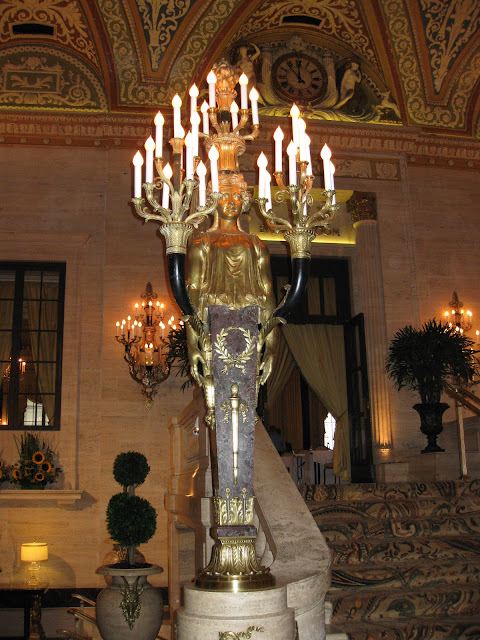
Attention is given to detail. Even these lamps look imperial.
This photo gives you an idea of the sheer length of the lobby and the great height of the ceiling.
The color combination of red, blue, and green is very striking. It's festive but very tasteful.
The Palmer House (now known as the Palmer House Hilton) was built by Potter Palmer as a wedding gift to his bride, Bertha Honore, and was completed in 1875. It was actually built to replace a previous hotel, also built by Palmer, which was destroyed by the Great Chicago Fire of 1871, just thirteen days after it opened. While I find the exterior of the Palmer House to be rather austere, and I don't recall ever seeing a photograph of the first hotel, the lobby of the Palmer House is a classic specimen of Gilded Age extravagance and splendor. A Chicago landmark, the Palmer House has had its share of famous guests, including, at its beginning, Sarah Bernhardt, Ulysses S. Grant, Mark Twain, and Oscar Wilde.
The Palmer House can also claim me as a previous guest, as once, several years ago, when I lived out West, I took advantage of a good deal to stay at the Palmer House during one of my visits back to my hometown. After all, how many people, other than myself, are crazy enough to visit Chicago in the frigid dead of winter? When I entered the lobby, I remember being simply stunned by its amazing beauty. A few days ago, when I returned for the purpose of taking photographs for my blog, I was still in awe of the lobby's beauty. Such intricate beauty is just not created anymore. Don't get me wrong, I love a lot of modern architecture, but the attention to detail that is very characteristic of older architecture is no longer a quality of modern architecture, with its simple, clean lines.
What I also like about the Palmer House is that it runs counter to some of the popular narratives about Chicago. Often, when people think of Chicago, they think of its sports culture, like the Chicago Cubs or White Sox, or they think of deep dish pizza or Italian beef sandwiches, or about Al Capone. When they think of Chicago architecture, they think of the work of Ludwig Mies van de Rohe, which is completely devoid of embellishment, and the work of other, similar architects. They don't always think of the high ornamentation found in the Palmer House's interior or the high cultural aspirations of Chicago's 19th century elite class. Not that I would want to live in such an age, with its social and economic inequality, but it's nice to walk into such a beautiful specimen of older architecture and, like with the lobby of the Rookery, feel yourself transported to that distant time, if only to enjoy the contrast between their sensibilities and those of our own age.
| Entrance staircase, Palmer House, Chicago, IL |
| Sconce detail, Palmer House, Chicago, IL |
| Lobby ceiling, Palmer House, Chicago, IL |
| Architectural relief detail, Palmer House, Chicago, IL |
| Lobby staircase with grand lighting feature, Palmer House, Chicago, IL |
| Wall mirror and Palmer crest, Palmer House, Chicago, IL |
| Floor light detail, Palmer House, Chicago, IL |
| Lobby ceiling, long view, Palmer House, Chicago, IL |
| Columns and architectural details, Palmer House, Chicago, IL |
Saying Goodbye to Chicago, Part Eighteen: The Loop, Vol. Five
James R. Thompson Center
I always call this the State of Illinois Building and so had to correct myself in naming it here. It was actually renamed in 1993 after one of our governors. The building opened in 1985 and was designed by Helmut Jahn, who, if I recall correctly, used the Thompson Center as inspiration for one of his architectural designs in Germany.
What I like most about the interior is its use of color and natural light. I also like its spaciousness, but I do wonder if the way that spaciousness was created has led to wastefulness, as there is a lot of open space that is not being utilized. The first two or three floors are devoted to retail use, while the State of Illinois has offices on the remaining floors.
Again, the use of a glass ceiling creates a naturally light and airy effect.
The red and the blue provide for a nice contrast with the neutral beige.
The design of the Chicago flag is not random. The three white bars of the flag represent the three parts of the city, the North, West, and South sides. The top blue bar symbolizes Lake Michigan and the bottom blue bar represents the Chicago River. The red stars represent pivotal events in the first one hundred years of Chicago's history: the establishment of Fort Dearborn on the site that would eventually become downtown Chicago; the Great Chicago Fire of 1871; the World's Columbian Exposition in 1893 (the one featuring the White City); the last star stands for the Century of Progress Exposition of 1933, which, obviously, featured a modernist theme.
There was talk a couple of years ago of adding a fifth star to the Chicago flag, if Chicago were to host the 2016 Olympics, but Chicago lost that bid to Rio de Janeiro. Frankly, I am happy that there won't be an opportunity to add a fifth star to the flag, as I like the thought that the four stars symbolize critical events of the city's first one hundred years, when the city was just establishing itself first as a city and then as a commercial and cultural center. I think those should be considered foundational events set apart from everything that happens going forward. They stand as pillars of Chicago's first century, supporting its rise upward into the ranks of world-class cities.
Along the River
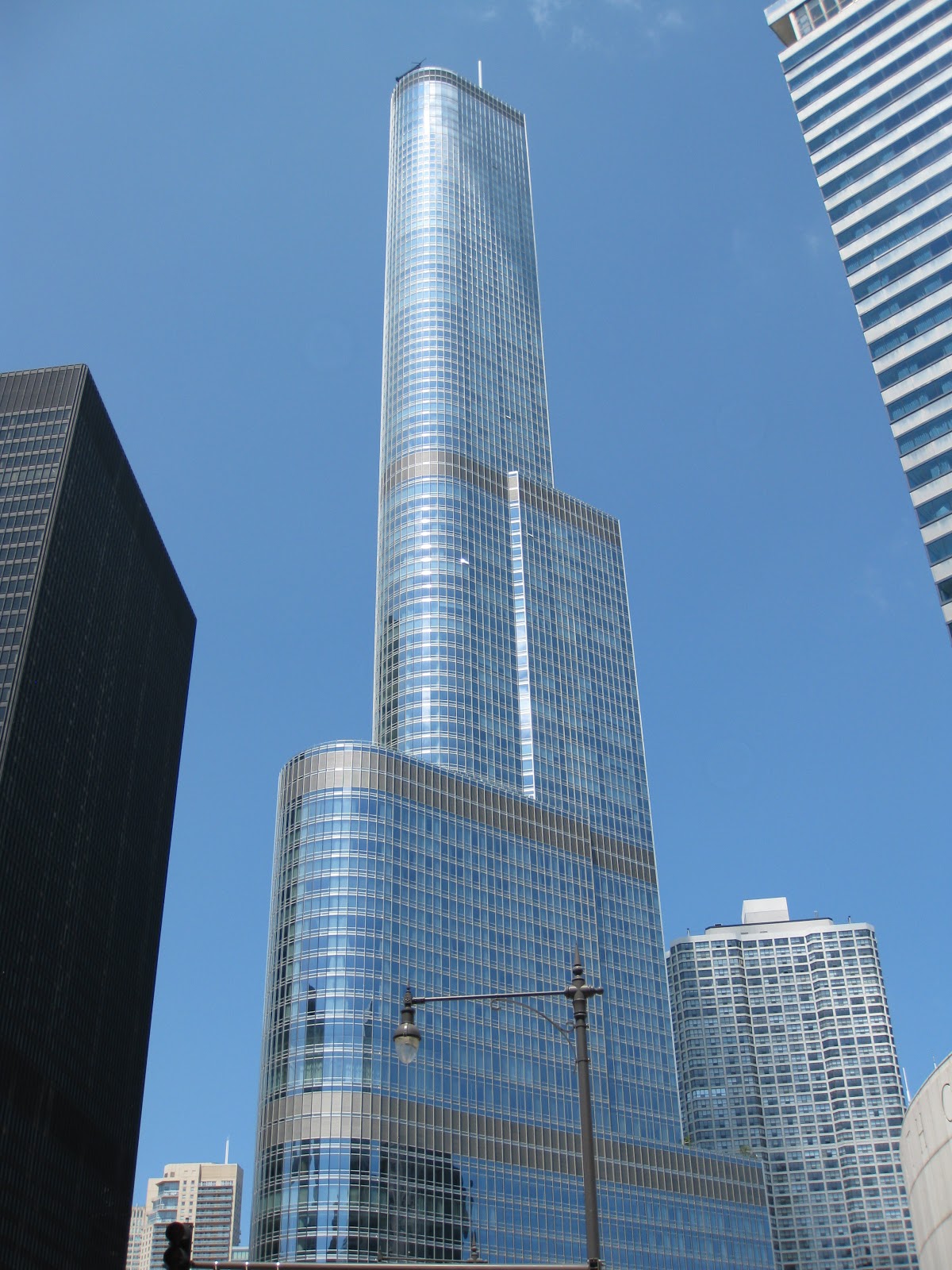
I always thought the name Marina City was a funny one for these two residential towers, as they look more like honeycombs than anything associated with the sea, but then it would probably sound silly, and maybe inappropriate, to call this place Honey Town. The IBM Plaza in the middle is another one of Ludwig Mies van der Rohe's big box designs, and the skyscraper on the right is the (relatively) new Trump Tower Chicago.
In the midst of the austerity of Chicago's modern architecture stand some of the beautifully more ornate "classic"buildings of the city: the domed Intercontinental Hotel, the white Wrigley Building, and the neo-Gothic Tribune Tower. The presence of historical buildings designed according to different sensibilities adds layers of architectural richness and complexity to Chicago's cityscape.
Aqua
Here is Aqua, one of the most beautiful of new skyscrapers to grace Chicago's skyline. The irregularity of its ridges, functioning as balconies for residents, creates a rippling effect, giving the observer the sense of water in motion and softening the edges of the building's overall rectangular structure.
Aqua is simply a brilliant piece of architecture. Another way to enjoy Aqua's beauty is by seeing it in collection with its neighboring skyscrapers from the vantage point of Millennium Park, which is just south of Aqua's location.
| James R. Thompson Center, Chicago, IL |
| Interior and elevator, James R. Thompson Center, Chicago, IL |
| Glass ceiling, James R. Thompson Center, Chicago, IL |
| Side detail, James R. Thompson Center, Chicago, IL |
| Side detail, James R. Thompson Center, Chicago, IL |
| Outside James R. Thompson Center, United Building, Chicago flag, Chicago, IL |
There was talk a couple of years ago of adding a fifth star to the Chicago flag, if Chicago were to host the 2016 Olympics, but Chicago lost that bid to Rio de Janeiro. Frankly, I am happy that there won't be an opportunity to add a fifth star to the flag, as I like the thought that the four stars symbolize critical events of the city's first one hundred years, when the city was just establishing itself first as a city and then as a commercial and cultural center. I think those should be considered foundational events set apart from everything that happens going forward. They stand as pillars of Chicago's first century, supporting its rise upward into the ranks of world-class cities.
Along the River
| Trio: Marina City, IBM Plaza, and Trump Tower, Chicago, IL |
| In the distance, Intercontinental Hotel, the Wrigley Building, the Tribune Tower, Chicago, IL |
| Trump Tower, Chicago, IL |
| Trump Tower and a bunch of buildings, Chicago, IL |
| Aqua, Chicago, IL |
| Aqua, front view, Chicago, IL |
Subscribe to:
Posts (Atom)