Showing posts with label Wrigley Building. Show all posts

Sunday, August 19, 2012

Moving On

Nature boardwalk, Lincoln Park, Chicago, IL
How do you encapsulate a city? How do you encapsulate a life spent in a city? How can you fully capture all of the unique and nuanced ways you have experienced living in your hometown? You can't. You simply take what photos you can, communicate what you can, and move on, trusting in your own good memory. You move on, trusting that what you lived for so long will continue to live in your heart, even after you have moved on. And it's all about moving on, it's all about movement.

Above is the southern stretch of Lincoln Park, near the Farm in the Zoo. Back in the day, during my years completing my undergraduate studies, when I rented my first apartment, I used to take long walks from the area of Clark Street and Belden through Lincoln Park and down this path along the pond, heading towards the Gold Coast area and downtown Chicago. Many times, Michigan Avenue would serve as the main artery for my walks, and so I would take it south into the Loop and then back north to Lincoln Park, where I would eventually head home. Back then, these walks served to reacquaint me with downtown Chicago, as I didn't go there often during my teenage years, and appreciate the beauty of my hometown and its wealth of retail, cultural, and nightlife options. As you can imagine, completing a college degree gets stressful, and so I took many such walks to explore my city. I think it was the first time that I truly fell in love with my hometown. Back then, this path along the pond was simple concrete pavement; today, it is a nature boardwalk, made to showcase the reintroduction of prairie plants to the park. Things change and life moves on.

How do you encapsulate a life spent in a city? You can't. You continue to move on, keeping what you can, such as photographs, and trusting in your good memory. I am excited about moving back to the Southwest, and I look forward to enjoying desert beauty again, and I also look forward to the addition of new content to this blog, but part of me will always love Chicago. Part of me will always be taking this walk through Lincoln Park, with the John Hancock Center looming high in the sky in the distance, down Michigan Avenue and around the Loop. Part of me will always be walking back north on Michigan Avenue, greeted by the white-clad Wrigley Building, heading back to Lincoln Park. Part of me will always be on a meandering path, and heading home.

Looking north on Michigan Avenue, Chicago, IL

Friday, August 3, 2012

Saying Goodbye to Chicago, Part Eighteen: The Loop, Vol. Five

James R. Thompson Center

James R. Thompson Center, Chicago, IL
I always call this the State of Illinois Building and so had to correct myself in naming it here. It was actually renamed in 1993 after one of our governors. The building opened in 1985 and was designed by Helmut Jahn, who, if I recall correctly, used the Thompson Center as inspiration for one of his architectural designs in Germany.

Interior and elevator, James R. Thompson Center, Chicago, IL
What I like most about the interior is its use of color and natural light. I also like its spaciousness, but I do wonder if the way that spaciousness was created has led to wastefulness, as there is a lot of open space that is not being utilized. The first two or three floors are devoted to retail use, while the State of Illinois has offices on the remaining floors.

Glass ceiling, James R. Thompson Center, Chicago, IL
Again, the use of a glass ceiling creates a naturally light and airy effect.

Side detail, James R. Thompson Center, Chicago, IL

Side detail, James R. Thompson Center, Chicago, IL
The red and the blue provide for a nice contrast with the neutral beige.

Outside James R. Thompson Center, United Building, Chicago flag, Chicago, IL 
The design of the Chicago flag is not random. The three white bars of the flag represent the three parts of the city, the North, West, and South sides. The top blue bar symbolizes Lake Michigan and the bottom blue bar represents the Chicago River. The red stars represent pivotal events in the first one hundred years of Chicago's history: the establishment of Fort Dearborn on the site that would eventually become downtown Chicago; the Great Chicago Fire of 1871; the World's Columbian Exposition in 1893 (the one featuring the White City); the last star stands for the Century of Progress Exposition of 1933, which, obviously, featured a modernist theme.

There was talk a couple of years ago of adding a fifth star to the Chicago flag, if Chicago were to host the 2016 Olympics, but Chicago lost that bid to Rio de Janeiro. Frankly, I am happy that there won't be an opportunity to add a fifth star to the flag, as I like the thought that the four stars symbolize critical events of the city's first one hundred years, when the city was just establishing itself first as a city and then as a commercial and cultural center. I think those should be considered foundational events set apart from everything that happens going forward. They stand as pillars of Chicago's first century, supporting its rise upward into the ranks of world-class cities.


Along the River

Trio: Marina City, IBM Plaza, and Trump Tower, Chicago, IL
I always thought the name Marina City was a funny one for these two residential towers, as they look more like honeycombs than anything associated with the sea, but then it would probably sound silly, and maybe inappropriate, to call this place Honey Town. The IBM Plaza in the middle is another one of Ludwig Mies van der Rohe's big box designs, and the skyscraper on the right is the (relatively) new Trump Tower Chicago.

In the distance, Intercontinental Hotel, the Wrigley Building, the Tribune Tower, Chicago, IL 
In the midst of the austerity of Chicago's modern architecture stand some of the beautifully more ornate "classic"buildings of the city: the domed Intercontinental Hotel, the white Wrigley Building, and the neo-Gothic Tribune Tower. The presence of historical buildings designed according to different sensibilities adds layers of architectural richness and complexity to Chicago's cityscape.

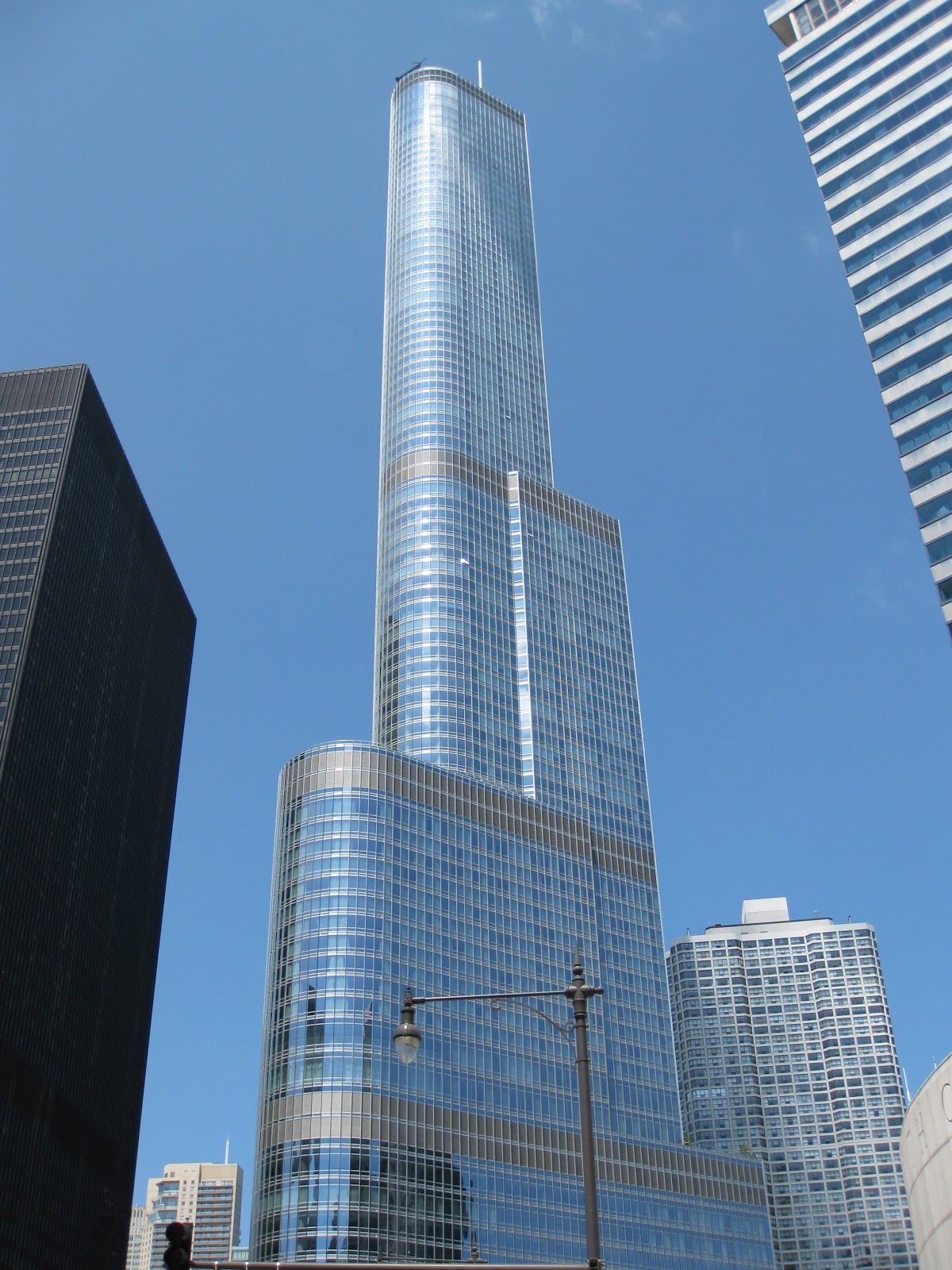
Trump Tower, Chicago, IL

Trump Tower and a bunch of buildings, Chicago, IL
Aqua

Aqua, Chicago, IL
Here is Aqua, one of the most beautiful of new skyscrapers to grace Chicago's skyline. The irregularity of its ridges, functioning as balconies for residents, creates a rippling effect, giving the observer the sense of water in motion and softening the edges of the building's overall rectangular structure.

Aqua, front view, Chicago, IL

Aqua is simply a brilliant piece of architecture. Another way to enjoy Aqua's beauty is by seeing it in collection with its neighboring skyscrapers from the vantage point of Millennium Park, which is just south of Aqua's location.

Wednesday, July 25, 2012

Saying Goodbye to Chicago, Part Eight: A Walk Down Michigan Avenue

Taking a walk down Michigan Avenue is much like taking a trip down Memory Lane. This is very much the iconic upscale commercial artery of the city, and a street that draws tourists from around the world. Some of my fondest holiday memories are of crowds packing the pavements of Michigan Avenue and entering and exiting its many vertical malls. I remember entering stores and hearing classic holiday songs played on stereo systems; I remember walking out and hearing the ringing of the Salvation Army bell. I remember the colorful Christmas lights that would enliven the early dark and illuminate the facade of the historic Water Tower. In other words, Michigan Avenue has been woven into the fabric of my life.

These photos, which I took today, are obviously summer photographs. There are no spruce trees strewn with colored lights or decorated with shining ornaments. Nonetheless, these photographs feature some of the most iconic architecture of Chicago. Michigan Avenue is a street that weaves together a variety of architectural styles built during different historical periods. Such a rich weave of multiple architectural styles is the mark of a great city, one that has grown organically over time and with a vision of itself large enough to encompass great diversity. Such a great city is Chicago.

Without further ado, here are photographs of Michigan Avenue.

Looking up at the John Hancock Center, Chicago, IL
Although I have always been partial to the beauty of the Sears Tower, the John Hancock Center has a simple, subtle modernist elegance. The metal beams that crisscross its facade give a sense of motion to what would otherwise seem to be just a chunky block of steel and glass.

The Tribune Tower, Chicago, IL
Home to the Chicago Tribune, the Tribune Tower has an intricate neo-Gothic design. Construction on the Tribune Tower began in 1923 and the building did not open until 1925.

Left to right: the Wrigley Building, Intercontinental Hotel, and the Tribune Tower, Chicago, IL
Together, this trio create a sense of history to serve as an architectural counterpoint to all of the modern architecture cropping up along Michigan Avenue. Without layers of classic architecture like these specimens, Michigan Avenue's architectural profile--indeed, Chicago's--would be far more simplistic and less interesting. It is this complexity that stirs the interest of so many.

Architectural relief, Intercontinental Hotel, Chicago, IL
I find this architectural relief to be fascinating. It seems to blend a variety of artistic styles, including ancient Egyptian, Assyrian, and ancient Greek. Just beautiful to see.

Neo-Gothic detail, Tribune Tower, Chicago, IL

Neo-Gothic detail above main entrance, Tribune Tower, Chicago, IL

Main entrance, Tribune Tower, Chicago, IL
I have always loved Gothic architecture and its elegant complexity. It always brings an element of the spiritual, even to a major commercial district such as this.

Entrance, Wrigley Building, Chicago, IL

Above entrance, Wrigley Building, Chicago, IL

Facade detail and skyway pedestrian bridge, Wrigley Building, Chicago, IL
So much of the architectural detail here is botanical, like flowers and leaves. Beautiful craftsmanship!
Aqua, Chicago, IL
The tallest building here is Aqua, a beautiful skyscraper that has won various architectural awards. Completed in 2007, Aqua is a mixed-use residential building. If you get closer and look up, those ridges start to look even more like waves, giving you the sense of water in motion.

Classic view of the city from Michigan Avenue Bridge, Chicago, IL
This view is simply beautiful. Old and modern architecture standing together.

Architectural detail, Michigan Avenue Bridge, Chicago, IL
I have used the Michigan Avenue Bridge to cross the Chicago River probably hundreds of times, and it is only recently that I have taken notice of this architectural detail, which numbers four, two placed on each end of the bridge.

Looking north on Michigan Avenue, Chicago, IL

Monday, July 23, 2012

Saying Goodbye to Chicago, Part Six: Three Landmarks

These photos were ones I took casually during three separate strolls around the city over the past year. Each is located in a different section of Chicago and are long-cherished landmarks of the city.


The Wrigley Building, Chicago, IL
Built to serve as the corporate headquarters for the Wrigley gum company, the Wrigley Building overlooks the Chicago River and today houses a variety of tenants. Opposite the Wrigley Building on Michigan Avenue stands the neo-Gothic Tribune Tower, headquarters for the Chicago Tribune & Company. (I plan to get a photo of that brilliantly designed building, too!) This photo I took last September, when the Wrigley Building had a large American flag draped over it in observance of the tenth anniversary of 9/11. We will never forget.

The Chicago Theatre, Chicago, IL
The Chicago Theater was built in 1921 and today serves with other historic theaters in the area to create former Mayor Daley's revitalized Theater District.

Biograph Theater, Chicago, IL
The Biograph Theater in Lincoln Park made history in 1934, when John Dillinger was shot by FBI agents in front of the theater. This theater still stands today. Having grown up in Lincoln Park, I can say that the Biograph Theater is one of the few things on this strip of Lincoln Avenue that has achieved longevity. Certain popular spots when I was growing up, like Wax Trax Records, where you could find an extensive selection of punk rock and new wave records and cassettes (yes, cassettes!) and the Red Lion Pub, have either gone out of business or moved elsewhere.